

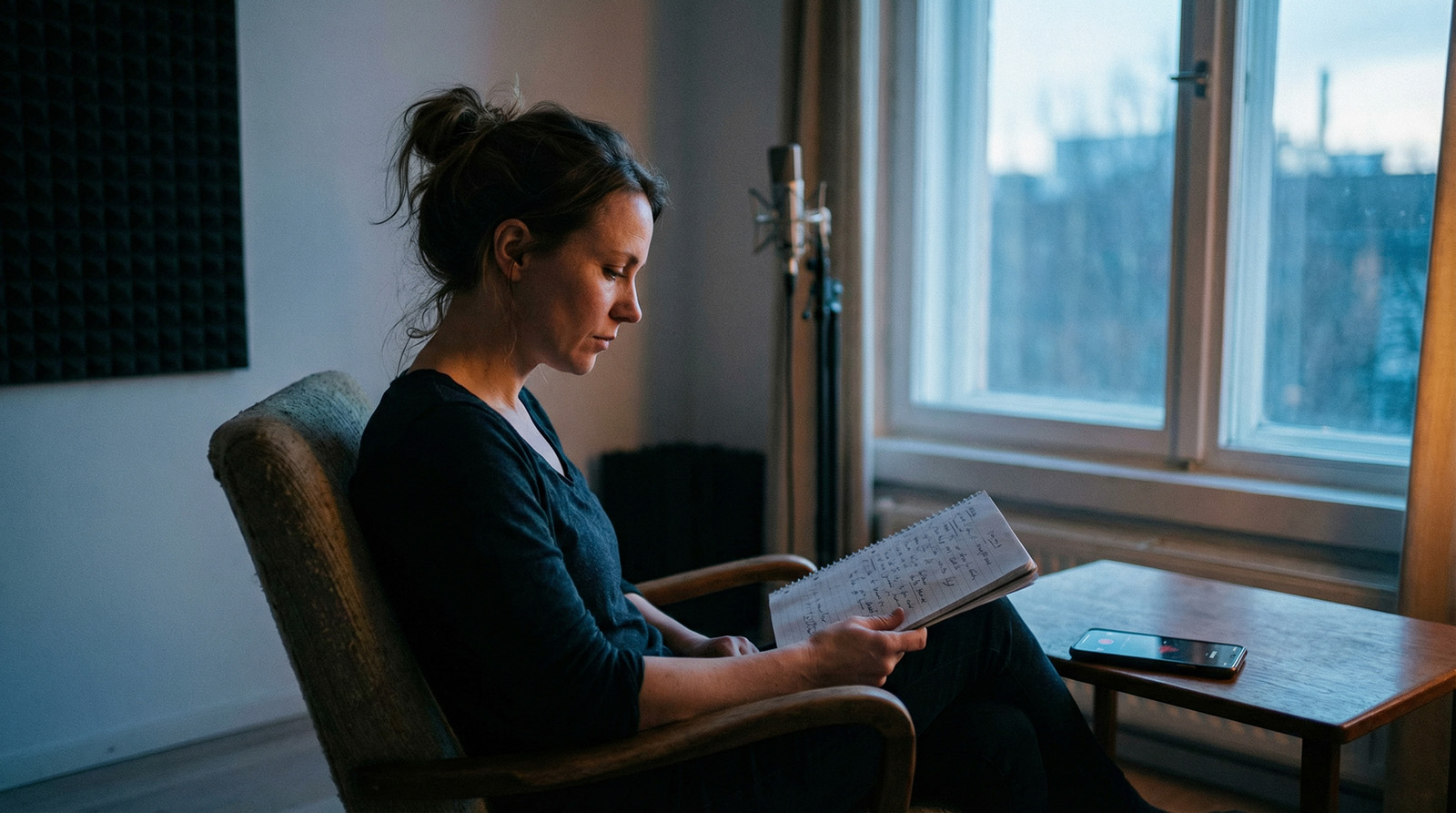
You practice. Not every day, but regularly. Maybe even with a clear conscience: a warm-up, a few exercises, then the song that matters to you. And yet it still sounds kind of… the same. Not worse. Just… not better.
That's the moment when many people start quietly negotiating with themselves. You can tell by the thoughts that settle on everything like dust: „Maybe I just don't have the voice for it.“ Or: „Others improve faster.“ Or the classic: „I just have to do more.“
I know this phase. Not from some self-help book, but from real sessions—and from the faces of the people sitting across from me when someone honestly says, „I’m investing time. I’m trying hard. Why isn’t anything happening?“
The uncomfortable truth: when it comes to singing, you can work very hard and still go around in circles. And the good news: that's rarely down to talent. It's almost always because that practice is confused with progress.
Your voice isn’t a piece of fitness equipment where you automatically lift more weight after three weeks. Your voice is about coordination. Precision. It’s an interplay of breath, the larynx, resonance, articulation, the nervous system—and what you tell yourself internally as you sing. When you sing without a clear focus, you’re training one thing above all else: your current pattern. You’ll get better at it, to sound the way it does now.
And yes: That can feel like a standstill. In reality, it's just Training Without a Direction.
In this article, I'll break it down clearly. Not with some "coach-speak," but in a way that leaves you with two things by the end:
- a clear reason why your practice isn't paying off right now—and
- A step-by-step plan for how you can start hearing real change again starting today.
You're confusing practice with repetition
Many people call it „practicing“ when they sing a song five times in a row. Or when they repeat the same YouTube exercise every other day. That feels like work. It is work. But it isn’t automatically learning.
Repeat means: You do something again.
Practice Meaning: You deliberately change one thing—and check to see if it really changes.
When you sing a song over and over again, this often happens: Your brain takes a shortcut. It goes on autopilot. You get through the difficult parts. You emphasize the words the way you’re used to. You breathe where you always breathe. And when a passage feels shaky, you think: „It'll work out next time.“ Spoiler: It usually doesn't work. Not because you're incapable—but because you're not giving the system any new information.
A voice doesn't learn through good intentions. It learns through precise stimuli.
If you don't define, what If you want to improve, your body can do only one thing: repeat what it already knows.
Here's an analogy I like to use:
Repetition is like walking „somewhere“ every day and wondering why you never get there. You’re moving—sure. But movement isn’t a destination. (Click: Targeted vocal exercises instead of endless repetition)
Why Progress in Singing Often Feels Invisible
In strength training, the message is clear: more weight, more reps, more muscle mass. In singing, the changes are often small, subtle, and unspectacular. And that’s exactly why many people overlook them—or dismiss them as „not real.“.
Progress in singing is usually Progress in Coordination. That means:
- A note is spot on minimal more stable.
- A transition will minimal easier.
- A vowel remains minimal remain open longer.
- You need minimal less pressure.
The problem: These small changes don't always feel good. Sometimes they even feel worse because you're stepping outside your comfort zone. A new, more efficient way of doing things can seem strange at first. Just like a new way of walking: objectively better, but subjectively unfamiliar.
And then there’s the mental trick: If you sing better today than you did four weeks ago, your mind doesn’t remember „four weeks ago.“ It compares you to yesterday. And yesterday might have been a good day. Or a bad one. Your voice depends on how you’re feeling that day, your sleep, stress, hormones, the weather, your daily routine—you know it yourself. If you measure progress only by how you feel on any given day, you’ll constantly believe that nothing is happening.
That's why I like to work by a simple principle: Progress is audible—but only if you make it comparable. (More on that later.)
The 5 Most Common Mistakes When Practicing Singing
Mistake 1: You're practicing too much at once
You want it to be higher, cleaner, more emotional, louder, and more stable—all at the same time—and, please, without any effort. That’s understandable. But here’s the thing: your system can’t handle five areas of improvement at once.
If you try to do everything at once, you’ll end up not practicing anything properly. You’ll jump from one problem to the next, and your body won’t receive a clear learning signal. A good session has a focus. Not ten.
Quick Fix: Before the session, write down exactly one sentence:
„Today I'm practicing: ________.“
For example: „Hold the vowel steady on the high note.“ Period.
Mistake 2: You practice songs instead of skills
Songs are the goal—but they're a poor training tool if you don't yet know, what you want to train there.
A song has too many variables: lyrics, rhythm, emotion, breathing, leaps, vowels, dynamics. If you just „practice the song,“ you’re often just practicing how to get through it.
Quick Fix: Take this from the song two measures. Or a line. And use it to practice a skill:
- Transition (tab)
- Vowel
- Breathing Techniques
- Articulation
- Intonation
It's less glamorous, but much more effective.
Mistake 3: You don't listen to yourself objectively
Many people rely on how their body feels when practicing. That makes sense—but it’s also a problem. Because your voice sounds different in your head than it does in the room. Bone conduction, natural resonance, perceptual filters.
When I ask people to record themselves, I often hear them say, quite honestly, „I hate it.“
I understand. But the camera isn't your enemy. It's the only reflection that doesn't lie.
Quick Fix: Record for 20 seconds. No longer. Then answer just one question:
„What is the one detail I want to clarify tomorrow?“
Mistake 4: You're waiting for that „good feeling“
Many people only practice properly when their voice is „there“—when it comes easily, when it’s fun. That’s only human. But it trains you to be dependent on that: „I can only do it if it's good.“
That's not how a pro behaves: You learn to keep going even on mediocre days clean to work. Not heroically. Neatly.
Quick Fix: Don't define success as „sounds awesome,“ but rather as:
- „I stayed focused.“
- „I've reduced the pressure.“
- „I practiced that part on its own.“
That's real work. And it all adds up.
Mistake 5: You practice without feedback
That's the biggest lever. And the most underestimated one. Without feedback, you're flying blind. You sense something, but you don't know if that's really what's getting through.
Feedback doesn't always have to come from a coach (even though that's obviously the quickest way). Feedback can also be:
- Recording + Comparison
- a clear checkpoint (e.g., „The tone remains steady“)
- a neutral listener who doesn't have to be nice, but rather honest
Without feedback, you'll become very good at what you're already doing. With feedback, you'll develop new patterns.
If you recognize yourself in more than one of these points:
I've turned this into a short checklist that you can use to plan each practice session in 10 minutes.

The 10-Minute Exercise Check
We'll email you the Quick-check right away.
How Proper Singing Practice Really Works
I keep it simple because the voice is already complex enough. For me, a good unit almost always consists of these three building blocks:
Step 1: Focus (1 minute)
You define something. It's non-negotiable.
Examples:
- „Keep your jaw relaxed when pronouncing high vowels“
- „Sound without breath“
- „Register transition without tilting“
- „Consonants clear, without pressure“
Step 2: Technique (6–8 minutes)
You practice this specific thing in a controlled environment—not throughout the entire song—using a clear pattern (e.g., a 5-note scale, a siren, short phrases).
Rule: If you don't know what you're working on, you're probably working on your problem.
Step 3: Transfer (6–8 minutes)
Now go to the song—but only to the part where the theme appears.
Two lines are enough. A snippet of the chorus is enough.
Step 4: Reflection (2 minutes)
A note. A sentence.
„What helped today was: ______.“
„Tomorrow, I'll pay attention to: ______.“
That sounds trivial. It isn't trivial. It's the difference between „I sang“ and „I practiced.“ (See also: Voice training is about coordination, not strength)
Why Feedback While Singing Is More Effective Than Practicing More
When you sing alone in a room, you’re the musician, the audience, and the sound engineer all at once. That’s a lot of roles for one brain to handle. And most of the time, one of them wins out: the one that protects you. The one that says: „It was okay.“ Or: „It was awful.“ Neither is usually precise.
Feedback does something crucial: It replaces drama with information. (Read more here: Personalized Feedback in Singing Lessons)
When I'm coaching, my job isn't usually to give „more exercises.“ My job is to make the vague concrete:
- Where does pressure build up?
- What happens during vowel change?
- Where does the register mix shift?
- What do you hear—and what's actually coming out?
And yes: You can also get feedback on your own—by recording, comparing, and doing a few quick checks. But if you've been stuck for weeks, outside feedback is often the quickest way to cut the Gordian knot.
If you'd like, send me a 60-second video of your workout. Not to evaluate you—but to tell you, which is one thing is most effective right now. (It's usually not what you'd expect.) to [email protected]
If you've been stuck for months, it's rarely your fault
I'm not saying this to flatter you. I'm saying it because it's true: Most people who „don't get any better“ aren't lazy. They aren't unmusical. They aren't „vocally limited.“ They're simply going about it without a clear system.
And that’s not a character flaw. It’s normal. Singing is a field full of half-truths, contradictory tips, and well-meaning advice that’s completely wrong for the wrong person. If you’re stuck for a long time, it’s often a sign that your focus is off—not that you’re the wrong person.
You don't need more discipline. You need a better direction. (See also: Why a Lack of Progress Has Nothing to Do with Talent)
The 10-Minute Practice Check: Are You Just Singing—or Are You Really Practicing?
If there's just one thing you take away from today, let it be this:
Practicing doesn't mean „more.“ Practicing means „more precisely.“.
Before you invest any more time, first make sure that, such as You're practicing.
The Practice Check is here to help you—no pressure, no theoretical fluff.
The 10-Minute Exercise Check
We'll email you the Quick-check right away.
And if you've reached the point where you're just wondering if you're going around in circles: Then get yourself a mirror that doesn't lie.
- Free Practice Audit: A 60-second audio clip—brief feedback with a specific focus during a free trial lesson.
- Or, if you want to get right to work in a structured way: Singing Lessons / Online Coaching – With a plan instead of guesswork.




0 Comments