

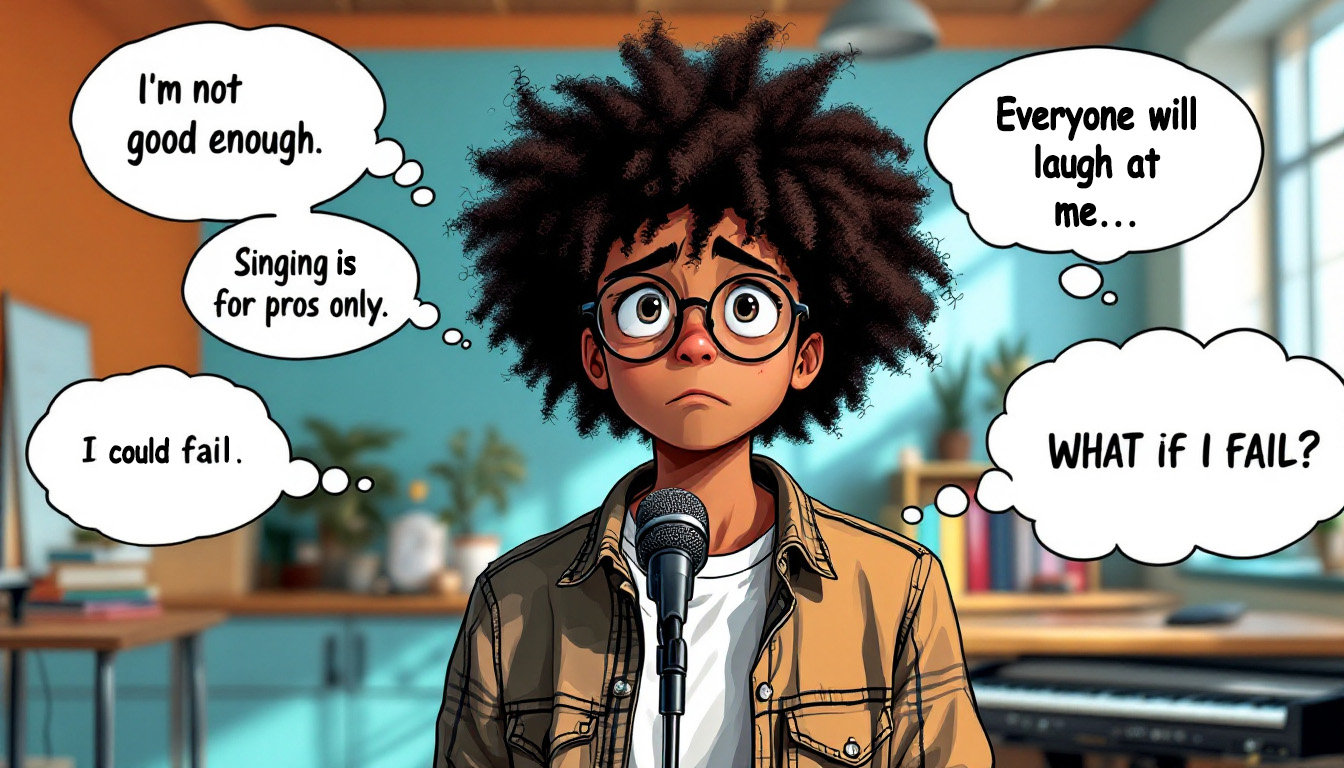
„I'm totally tone-deaf.“
„When I sing, everyone runs away“
„My voice sounds terrible“
If you recognize yourself in any of these statements, you’re not alone. Nearly half of all beginners come to us with this thought—and almost all of them leave their first session with a smile. Not because we can work magic, but because these statements rarely have anything to do with your actual voice—and much more to do with self-image, school experiences, and societal myths about singing.

Where does the fear of singing come from?
Many people carry a formative negative experience with them: a teacher who cut singing from the curriculum; someone laughing at them in choir; or a well-meaning comment like, „Singing just isn’t your thing.“ These inner voices often stay with us for decades.
Yet what we call „talent“ is, to a large extent, something that can be developed. The Vocal Coordination, the Singing by Ear, even that Sense of rhythm – All of this can be developed in a targeted manner.
→ Online Singing Lessons at CK Voice Lessons
What does „not being able to sing“ even mean?
I often hear people say in the studio, „I just can’t hit the right notes.“ But in over 90 % of cases, there is no pitch disorder („amusic“). Much more often, it’s simply a matter of an untrained ear or a lack of body awareness. Vocal control isn’t a talent—it’s a combination of Body Tension, Breathing, and Auditory Feedback.
How to Break Free from Negative Beliefs
So what should you do? The most important first step is: Realize that your voice is not a fixed state. It's an instrument that you can learn to tune and play.
👉 In the Performance Coaching We focus specifically on building mental strength and self-confidence, and on quieting our inner critic.
Practical Tip:
Record yourself singing with your cell phone—not to judge yourself, but to track your progress. Listen to older recordings regularly and notice how your vocal feel changes.
Why Your Voice Is Unique
One point that is often underestimated: Our own voice always sounds strange to us. Why? Because of what is known as Bone Conduction Resonance. So we never hear ourselves the way others hear us. And what sounds shaky to us may already sound pleasant and steady to outsiders.
That's why the best way to overcome voting uncertainty is: Out of your head—into your body.
→ If you want to get started: Click here for the new customer trial package
Take heart: You can do more than you think
If you think you can't sing, it's usually not because of your voice—but because of your inner monologue. You can train your voice. You can train your ear. And your expression, of course. The key question isn't, "Can I do this?" but rather: How can I learn it, and with whom?
And we'll show you how. No pressure. With joy. With a method.



0 Comments